

Starting a nucleic acid therapeutic or vaccine programme is undeniably a challenging and technically complex journey, but one that is deeply rewarding from both a scientific and patient-impact perspective.
The science is young, the variables are many, and choices made in the initial stages shape everything that follows. For teams considering a technology partnership, the most practical question is often the simplest one: What does this entail in practice?
This article walks through the full arc of a technology partnership with etherna, from the initial conversation through to clinical studies.
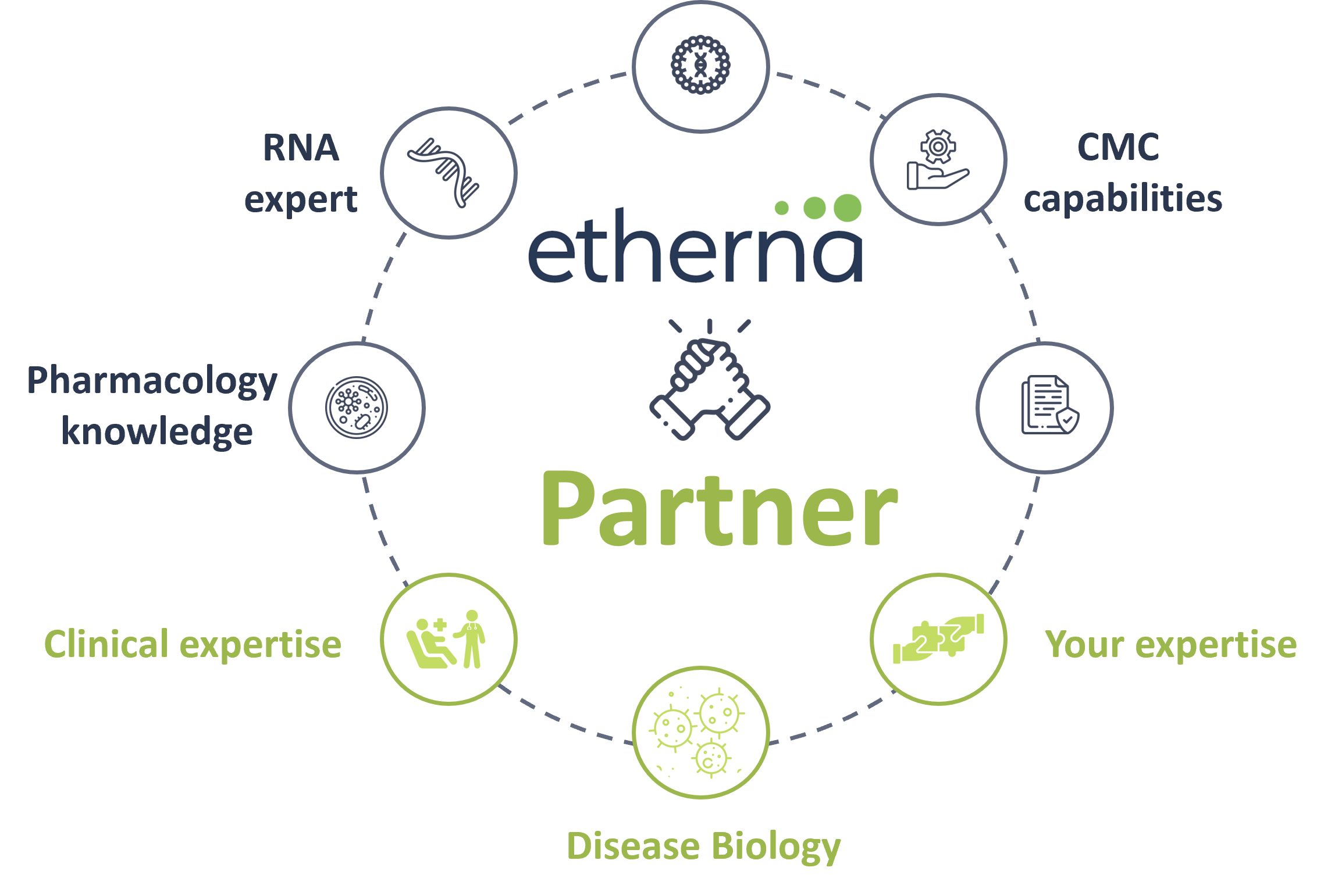
Stage 1: Mutual Discovery
The first conversation with etherna is a scientific scoping discussion.
Before any agreement is in place, our team works to understand the fundamentals of your programme: the target and its mode of action, the indication, the payload type, the intended route of administration, and the stage you are at. This is where we determine whether our platforms are the right fit, early and direct feedback helps to prevent misaligned expectations and unnecessary downstream risk.
For most programmes, the key questions at this stage focus on payload and its delivery. The payload’s type and mode of action define the required delivery profile, driving decisions around lipid nanoparticle biodistribution, immunogenicity, repeat‑dosing feasibility, and the stability and encapsulation characteristics needed for success.
This stage typically takes one to two meetings. The outcome is a shared understanding of the scientific challenge and a clear view of which etherna platforms are relevant to your programme.
Stage 2: Feasibility and Platform Selection
Once a fit is established, the partnership formally begins with a feasibility phase. This is where scientific hypotheses are tested and the most appropriate LNP platform is identified for your application.
etherna’s platform portfolio includes six distinct LNP systems. These cover liver-targeted intravenous delivery, hematopoietic stem cell delivery, T‑cell delivery[TV1] [VA2] , tolerizing formulations, intramuscular vaccine delivery, and intratumoral administration. Each platform has a defined biodistribution profile, immune behaviour, and payload compatibility. Selecting the appropriate LNP candidate involves screening payload performance and/or tissue-specific delivery across LNP formulations rationally selected based on the differential properties of our proprietary ionizable lipids.
During feasibility, etherna scientists work closely with your team to define the formulation strategy, scientific criteria, and decision points relevant to your programme. etherna provides platform insight, comparative guidance, and interpretation frameworks, while experimental execution remains with the sponsor team. The outcome is the identification of a lead LNP candidate, supported by shared data and a clear, jointly agreed rationale for progressing the programme.
Typical duration: two to six months, depending on programme complexity and payload availability.
Stage 3: Lead Platform Optimisation
With a lead LNP candidate selected, the focus shifts to optimising performance for the specific payload and indication. This is where customisation delivers its greatest value.
Optimisation runs across several dimensions in parallel: optimization of ionizable lipid chemistry leveraging a library of more than 2,500 proprietary molecules, adjustment of LNP composition ratios, and evaluation of conjugation strategies for active targeting when required.
Throughout this stage, etherna provides the experimental infrastructure and delivery expertise, while your team brings disease understanding, target biology, and clinical intent. It is a genuine co‑development model, with joint decision‑making driven by data.
The outcome is a defined LNP formulation with characterised performance across the parameters that matter most, including expression level, biodistribution, tolerability, and stability.
Typical duration: three to six months
Stage 4: Preclinical Development and Clinical Studies
Once the lead LNP formulation is locked, the programme transitions into formal preclinical development. At this point, etherna’s integrated manufacturing capability becomes central.
LNP formulation expertise and GMP manufacturing activities are tightly coordinated in Belgium, with the transition from research‑grade material to GMP production actively managed internally, combining in-house mRNA GMP manufacturing (if required) and externally executed LNP GMP manufacturing. This integrated setup minimises handoffs, reduces reformulation risk, and preserves process knowledge around how each specific LNP behaves. Where additional specialised assays or studies are required, etherna works with qualified third‑party vendors, while retaining scientific oversight and integration of the resulting data.
By the end of this stage, the programme has a characterised, GMP‑manufactured LNP‑RNA product candidate, supported by an integrated data package and ready to advance into clinical development.
Typical duration: eight to twelve months, depending on regulatory pathway and study design.
What Makes This Model Different?
Many nucleic acid-based therapy programmes rely on multiple vendors across the development journey. One partner for sequence design, another for LNP formulation, and a third for GMP manufacturing. Each handoff introduces risk, reformulation, timeline delays, loss of process knowledge, and gaps in accountability.
etherna operates an integrated model that spans RNA chemistry (if required), LNP formulation, and GMP manufacturing. A programme that begins with platform selection reaches IND with the same scientific team, the same proprietary materials, and a manufacturing process designed alongside the formulation rather than adapted after the fact.
For programmes where speed and risk reduction matter, this integration is a strategic advantage, not a convenience.
Is a Partnership with etherna Right for Your Programme?
A technology partnership with etherna works best for teams that meet most of the following criteria. You are working with nucleic acid payloads and require a differentiated delivery solution. You are in early discovery through late preclinical development. You are looking for a science‑led partner rather than a transactional manufacturer. And biodistribution, targeting, or immune modulation is a central technical challenge in your programme.
If that reflects your situation, the right next step is a scientific conversation with our team.
Frequently Asked Questions
At what stage of development should we approach etherna?
etherna supports programmes from early discovery through IND and beyond. Early engagement provides the greatest opportunity to influence platform selection and RNA design. We also work with teams reformulating existing programmes or addressing manufacturing challenges mid‑development.
How long does it typically take to go from first conversation to IND?
A typical partnership spans twelve to eighteen months, progressing through feasibility, lead optimisation, and preclinical development. Programmes with well‑defined payloads and clear target profiles often move faster.
What does co‑development mean in practice?
etherna contributes platform expertise, proprietary lipid libraries, experimental infrastructure, and manufacturing capability. Your team contributes disease knowledge, target biology, and programme strategy. Scientific decisions are made jointly, guided by data at every stage.
Can etherna support programmes beyond mRNA?
Yes. etherna’s LNP platforms support multiple nucleic acid payloads, including DNA, circular RNA, saRNA, tRNA, siRNA, and antisense oligonucleotides.
Does etherna handle GMP manufacturing, or is this a separate engagement?
GMP manufacturing is an integrated part of etherna’s offering, including in-house mRNA GMP manufacturing. Core LNP GMP activities are managed in‑house, while LNP GMP manufacturing is performed with carefully selected external manufacturing partners. etherna works in close alignment with these vendors, maintaining scientific, technical, and quality oversight throughout the process to ensure consistency, robustness, and the highest product quality from development through clinical supply.
etherna is a pioneer in nucleic acid‑based medicine development, combining deep delivery science with integrated manufacturing expertise headquartered in Niel, Belgium. etherna partners with innovators to translate Nucleic acid-based therapies from concept to the clinic. To discuss your programme, Contact our team.